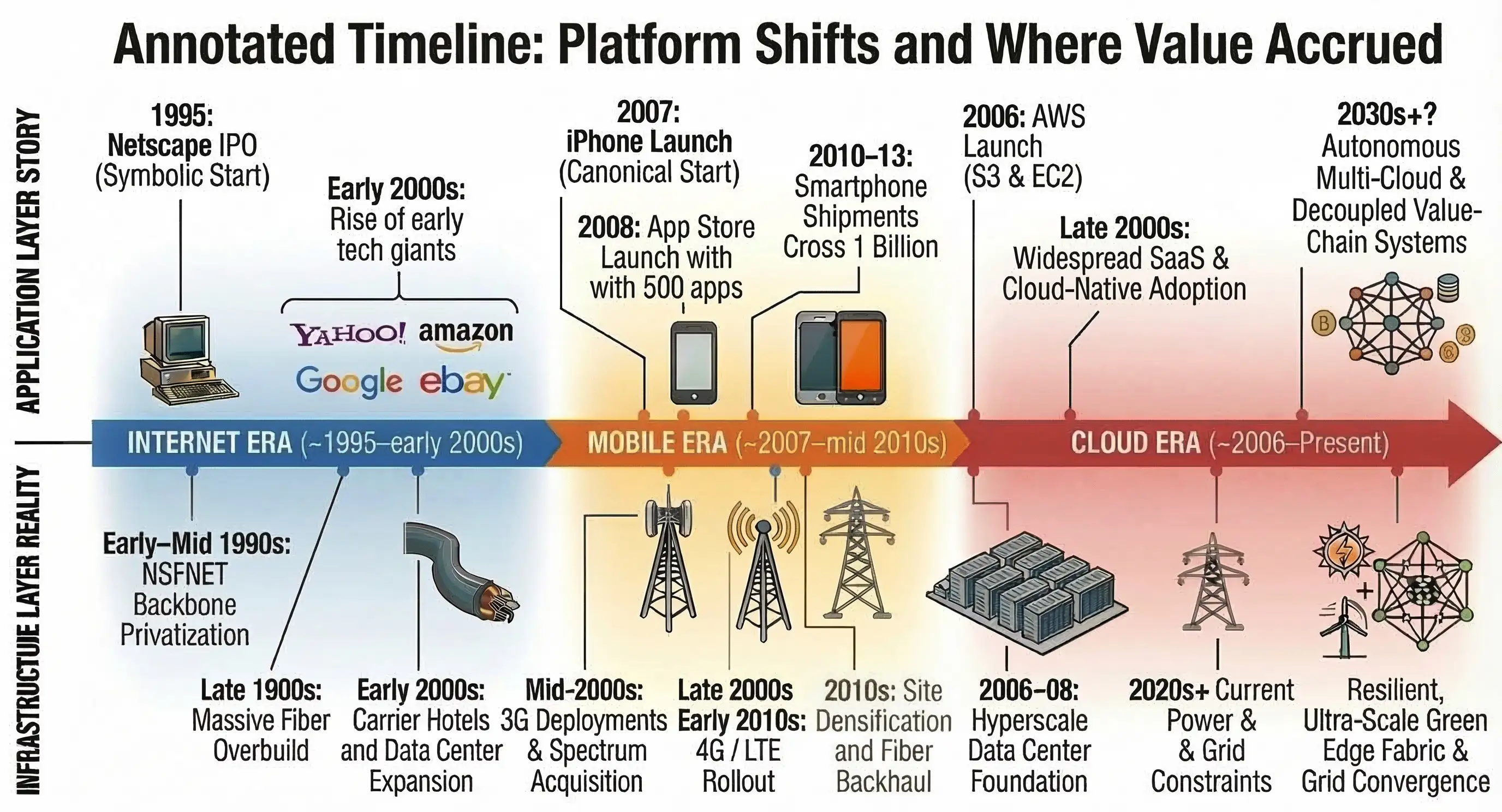
There's a pattern in how platform markets get won that tends to get lost in the retelling. The story we tell afterward centers on the application: the browser, the search engine, the social network, the model. The story happening in real time, before anyone knows how it ends, is almost always about infrastructure.
The internet's application layer transformed how the world communicates and shops and finds information. What made that possible was a decade of largely invisible investment in fiber, routing infrastructure, and data center buildout, the physical substrate that applications run on. Mobile looked like a software story from the outside. From the inside it was a spectrum and tower story, and the companies that owned those assets set the terms that everyone else operated within. Cloud computing is still narrated as a software and services business. The actual competitive moat, the thing that made AWS defensible when Azure and Google Cloud came after it, was physical: real estate, power, and the operational knowledge of running infrastructure at scale in dozens of geographies simultaneously. That takes years to replicate. Software doesn't.
The pattern is consistent enough to be worth taking seriously: in every major platform shift, the durable positions get built at the infrastructure layer. Application builders move fast and capture attention. Infrastructure builders move deliberately and capture the market.
Edge AI is in the early chapters of the same story. The conversation is dominated by models, use cases, and verticals, all legitimate, all worth having. But it's not where the lasting positions are being established.
The constraint that matters
Every platform shift has an enabling constraint, a specific bottleneck that once solved unlocks the rest of the stack. For edge AI, that constraint is power. Not compute, since GPU availability has tightened and loosened in cycles and the trajectory is toward abundance. Not networking, since fiber and 5G coverage have expanded faster than most forecasts predicted. Power is what's left, and it's the constraint that doesn't have a near-term resolution.
The United States doesn't have a generation problem. Wind farms in Texas produce surplus in certain hours. Nuclear runs steady. The problem is deliverability: getting that power to where new loads need it, on timescales those loads actually require.
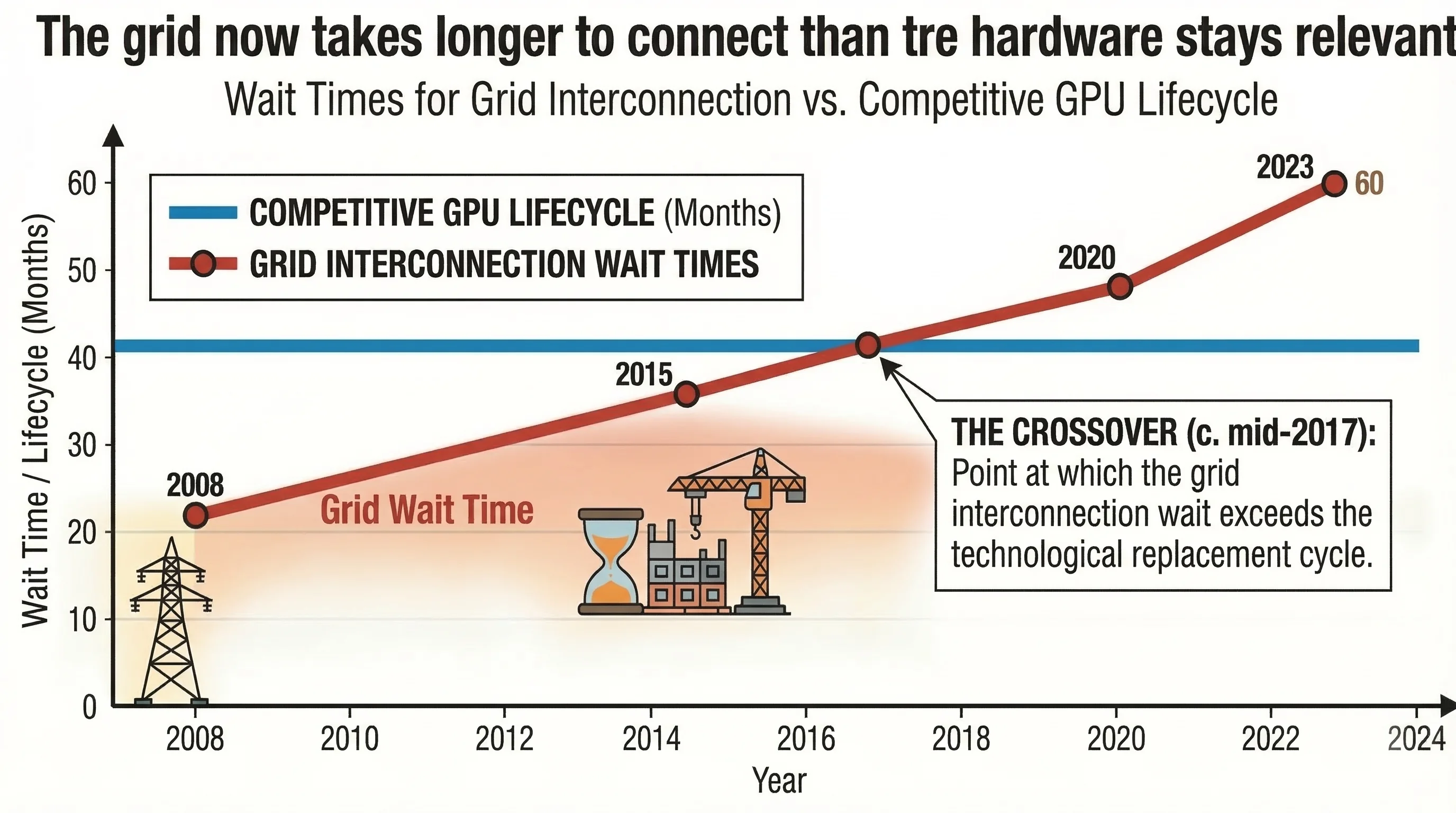
Lawrence Berkeley National Lab tracks every project seeking grid interconnection in the US. Their most recent data shows a median wait time of 55 months from application to commercial operation. That was 36 months two years ago and 22 months in 2008. Meanwhile, the useful commercial lifecycle of an H100 is 36 to 48 months before the next generation makes it uncompetitive for frontier tasks. The median grid connection now takes longer than the hardware it's meant to power stays relevant. That's not a bottleneck you optimize around. That's a structural mismatch between two systems operating on completely different clocks.
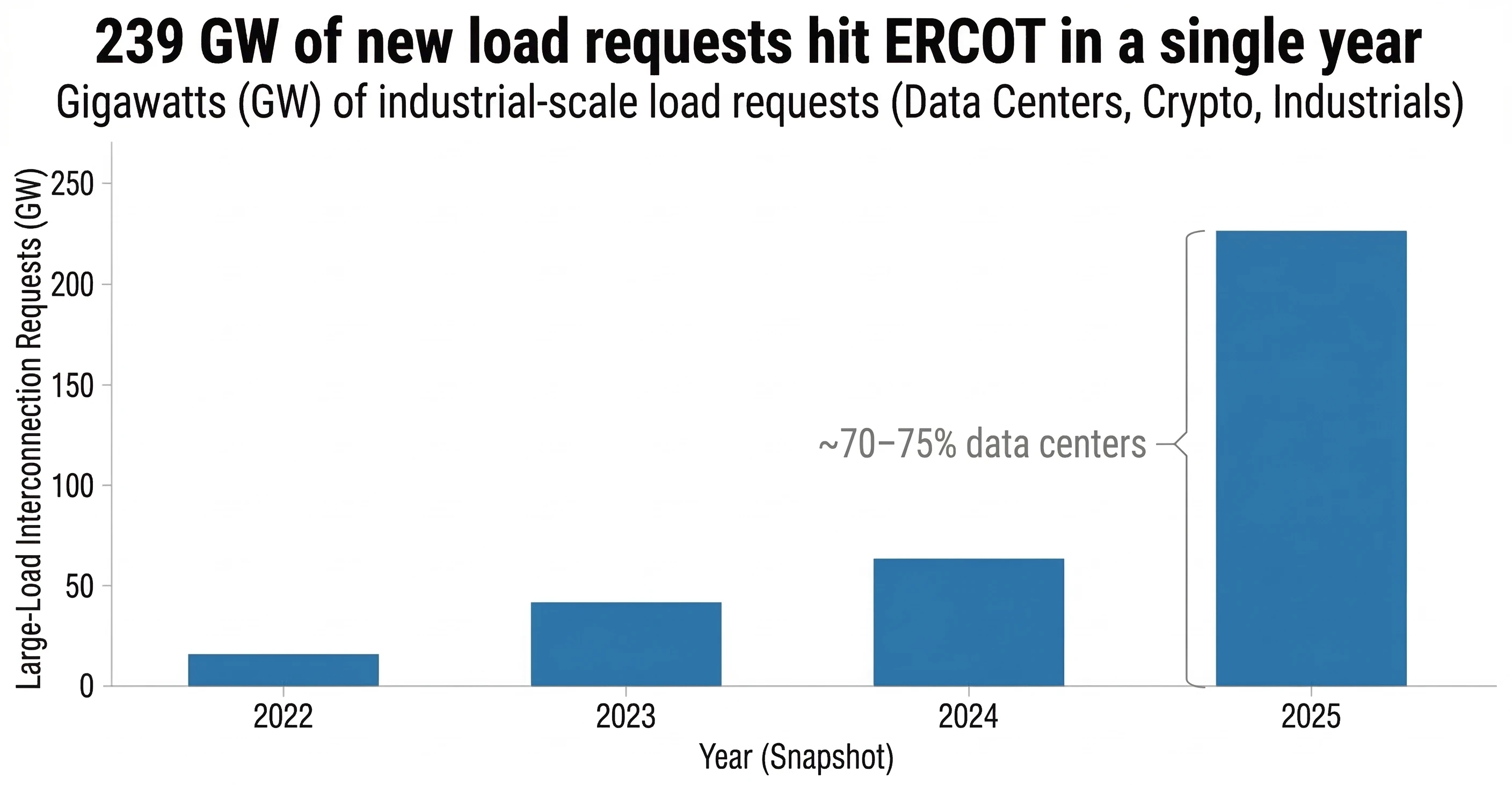
CAISO and PJM, managing nearly 30% of US electricity, stopped accepting new interconnection applications entirely in 2024. ERCOT reported 239 gigawatts of large load requests as of late 2025, a 300% increase in a single year. The grid will catch up eventually. That's a decade-scale timeline, and the edge AI buildout is not waiting for it.
Where the assumption breaks down
The edge AI conversation has a blind spot that's worth naming directly: smaller facilities do not mean easier deployment.
Large datacenter development has always followed power. You put the facility where electricity is cheap and connection is feasible, and accept that it'll be in rural Texas or eastern Oregon if that's where the economics point. Latency doesn't matter for training. A model being trained in Wyoming serves the same function as one trained in Dallas.
Inference is different. It has to be near the workload, because autonomous systems, robotics, and real-time processing can't absorb the round-trip to a remote facility. That geographic constraint pushes edge AI into dense urban environments and specific industrial corridors, exactly the places where distribution grids are most congested, permitting is most complicated, and community opposition is most organized.
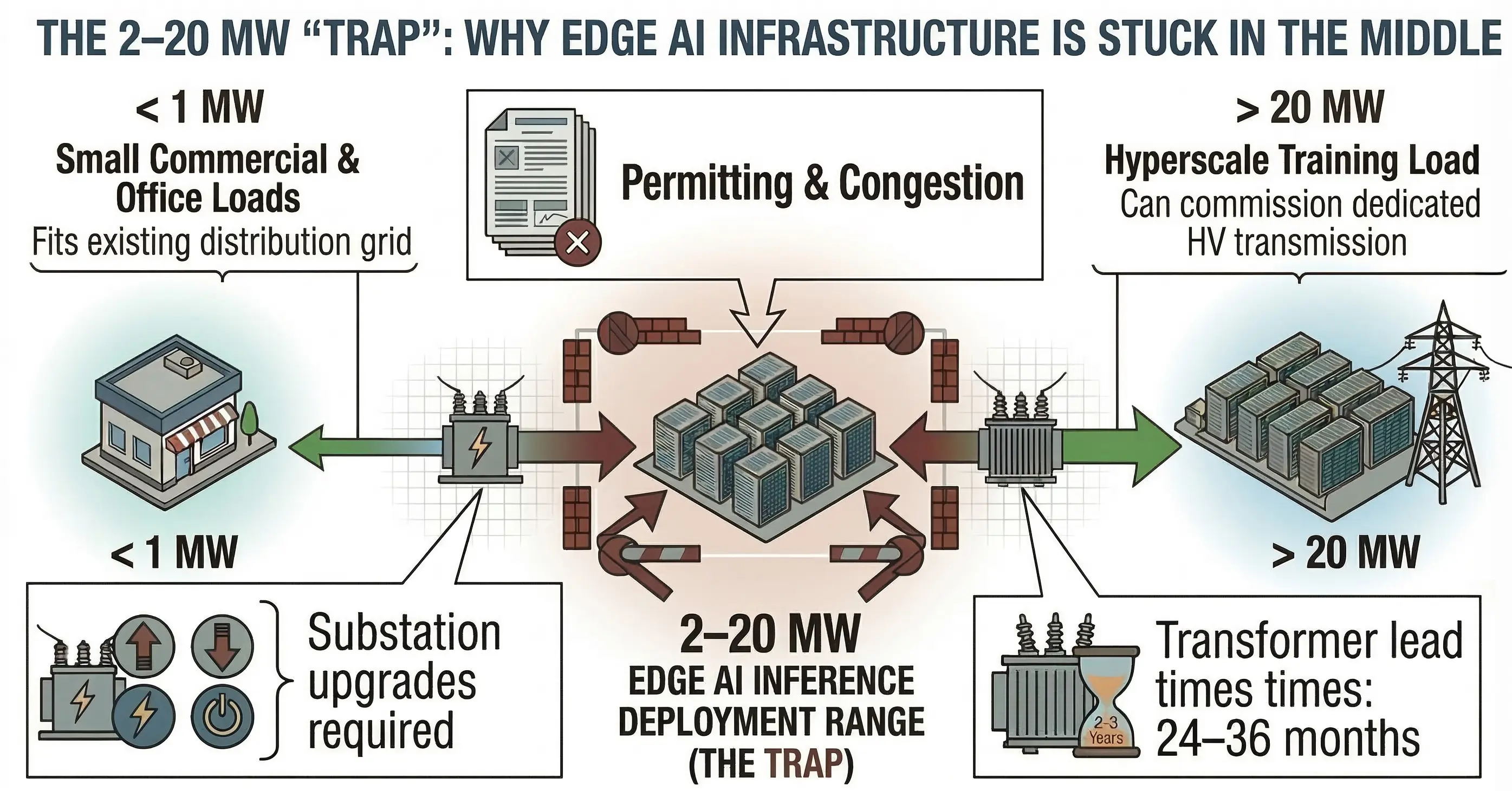
The 2 to 20 MW range that edge inference deployments typically require sits in a specific trap that doesn't get discussed enough. Too small to justify the dedicated high-voltage transmission infrastructure that hyperscalers can commission. Too large for urban distribution grids to absorb without substation upgrades and transformer replacements, and the supply chain for distribution-level transformers currently runs 24 to 36 months. So you're not just waiting for a grid connection. You're waiting for equipment that's waiting for a grid connection.
None of this means edge AI infrastructure is impossible. Load sizes in this range aren't novel, since factories and commercial complexes have been connected at 2 to 20 MW for decades. What's novel is the location pressure and the speed requirement. Doing it in a congested urban environment on a timeline measured in months, against a grid that wasn't designed for it, is a genuinely harder problem than most deployment forecasts account for.
The logic of the wedge
The operators establishing real positions in edge AI right now are not waiting for perfect infrastructure conditions. They're moving with bridge power: modular, behind-the-meter, fuel-agnostic generation that costs more per kilowatt-hour than grid power and can be operational in weeks rather than years.
The cost premium looks uncomfortable until you think about what delay actually costs. At current GPUaaS pricing, 1 MW of power supporting roughly 1,000 H100s at 85% utilization generates around $1.24 million per month in gross revenue. A 10 MW deployment is over $12 million monthly. Against those numbers, paying a meaningful premium for power available now versus power available in four years is straightforward. Every month of delay isn't just deferred revenue. It's deferred relationships, deferred operational learning, deferred credibility in specific markets. The enterprise contracts go to whoever shows up first with working infrastructure. That's not a controversial claim. It's just how markets form.
What's less obvious is what happens next. By the time the grid catches up in a given market, the operators who moved early aren't defending bridge power economics against grid economics. They're defending incumbency. And incumbency in infrastructure compounds differently than in software. A competitor with a better application can displace an incumbent quickly. A competitor with better infrastructure in a market where relationships and operational knowledge are already established faces a much harder problem.
The real logic of bridge power as a strategy is not that it's the permanent answer, but that it's how you get into markets before they're settled. The grid will eventually serve edge AI. The question is whether you're already the established operator in a given geography when it does, or whether you're entering a market where someone else has been running infrastructure for three years.
What this moment is
There's something clarifying about markets that are forming faster than the infrastructure meant to support them. The companies that recognize the constraint as the opportunity, that understand solving power in difficult environments at speed is precisely how durable positions get built, are the ones taking ground right now. Not with perfect solutions. With working ones.
The edge AI buildout is happening in locations the grid wasn't designed to serve on these timescales, with power solutions that cost more than anyone would choose if cheaper options were available on the same schedule. The infrastructure positions being established quietly in secondary markets, running on generation that deploys in weeks, are the ones that will look obvious in retrospect.
They always do.