
The Clock That Changes Everything
Edge AI infrastructure doesn't have a default provider yet.
No dominant operator. No standard power solution. No established playbook for deploying compute in dense urban environments at speed. The terms of this market are still being written.
In every infrastructure market that preceded this one, there was a moment when it stopped applying. Not dramatically. One contract and one location at a time, until the shape of the market was fixed and the second layer of entrants was competing for what the first layer hadn't taken.
That moment is coming. The question is whether you're on the right side of it when it does.
Time to power
AI inference infrastructure generates in the range of $10 to $12 million per MW per year in gross revenue. A 10 MW edge deployment running a year earlier than a competitor isn't just ahead on revenue. It's $100 million ahead, with enterprise relationships and market position that don't show up in a kilowatt-hour comparison.
The military has a term for this: the fully-burdened cost of fuel. Not the per-gallon price, but the full weight of logistics, risk, and everything that couldn't happen while waiting for supply. The equivalent for edge AI is the fully-burdened cost of delayed deployment. Most operators aren't calculating it.
Distribution-level grid interconnection at 2 to 20 MW takes 6 months in the best case, with spare capacity and no infrastructure upgrades. In dense urban environments, grid upgrades can push realistic timelines to 2 to 4 years. An operator starting that process today in a typical constrained urban market could be looking at 2028 or 2030 before they're operational, entering a market they planned around 2026 conditions.
The grid connection they waited for didn't just cost them time. It delivered them into a market they didn't build for.
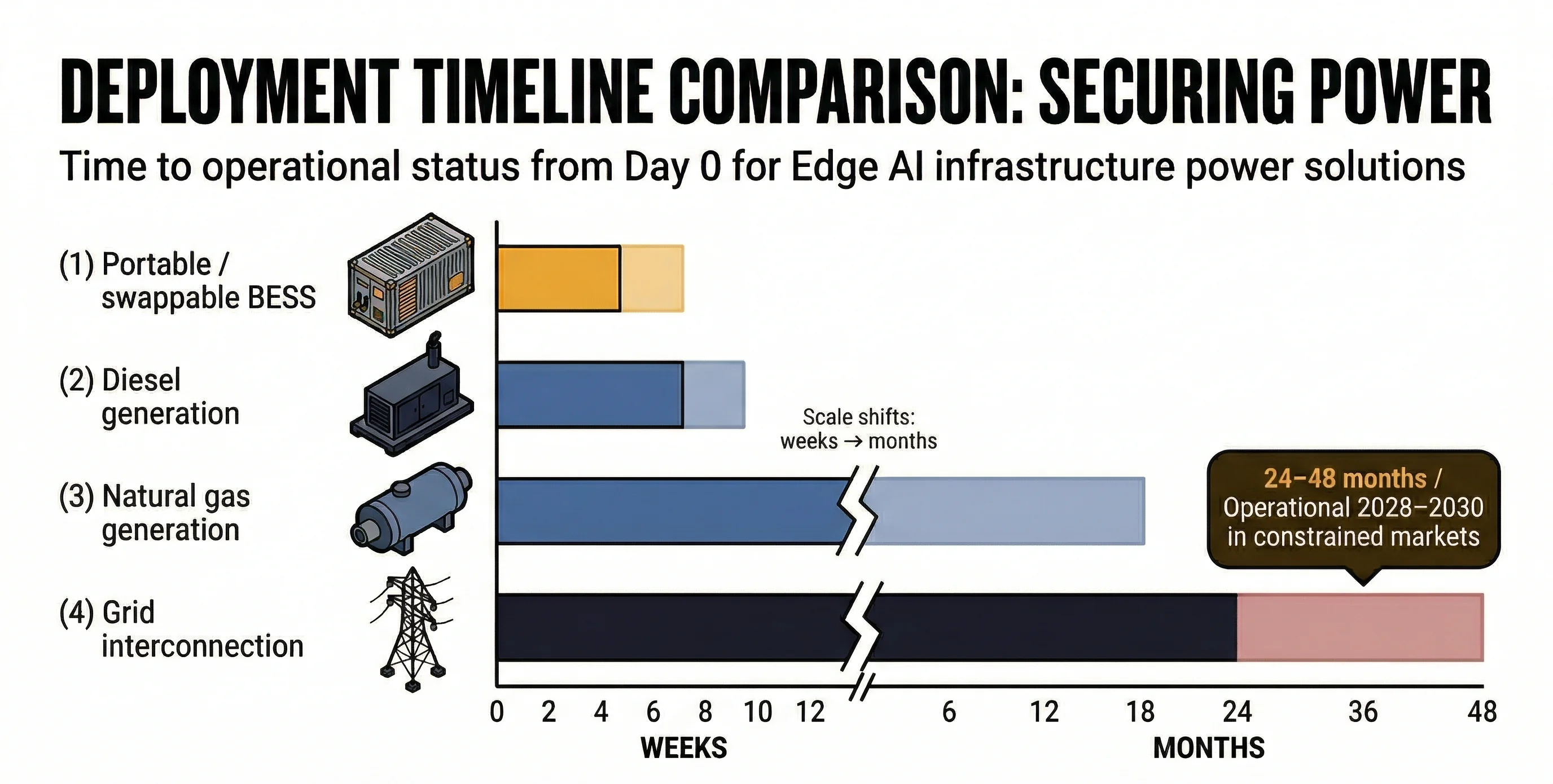
Diesel made sense until it didn't
For a long time, diesel was the obvious bridge power answer. Fast to deploy, widely available, straightforward to operate. If you needed temporary power at scale, you called someone with generators.
Two things have broken that.
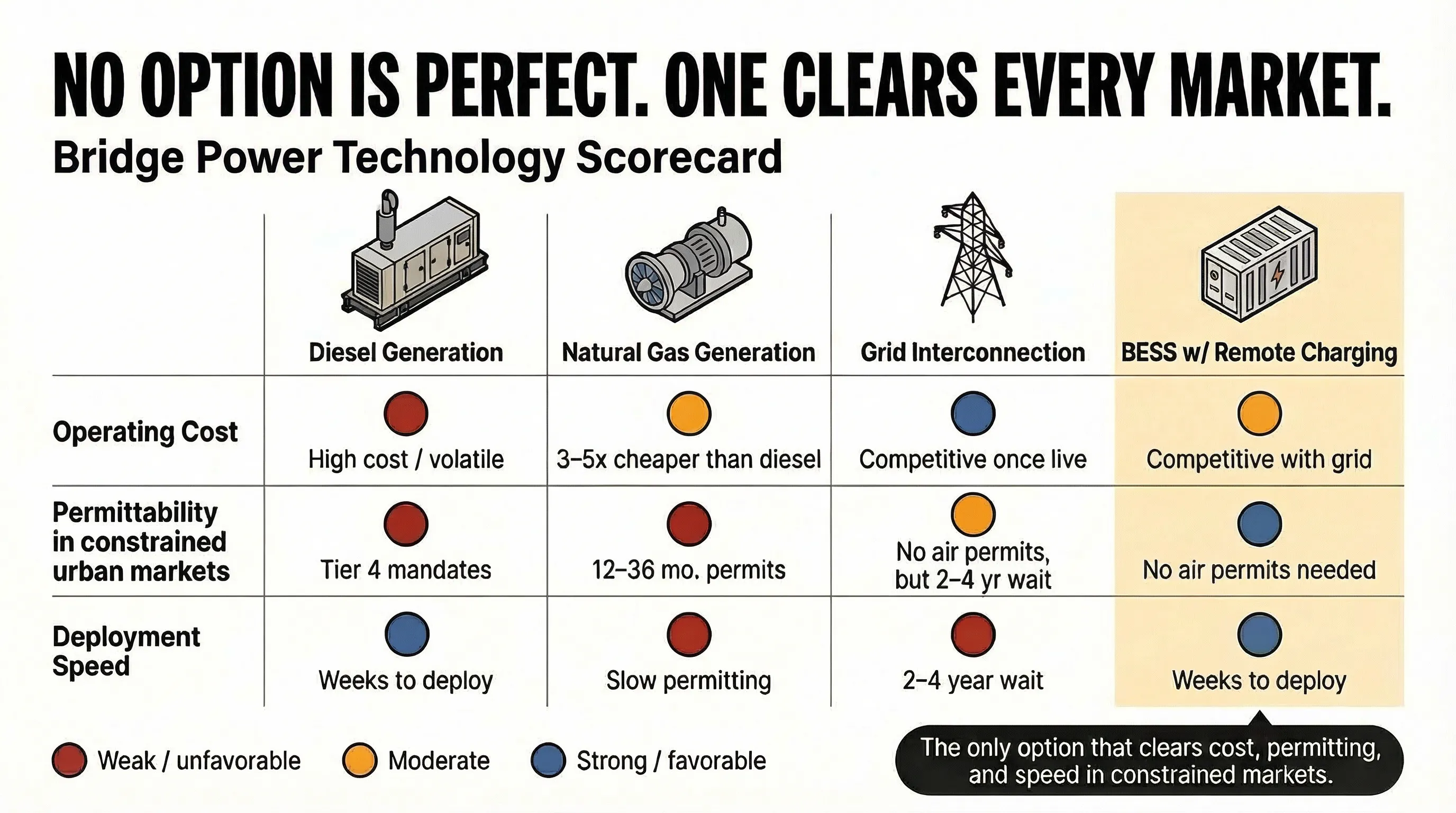
The first is cost. All-in diesel bridge power runs $0.28 to $0.43 per kilowatt-hour at 10 MW scale. Fuel represents 70 to 85 percent of operating cost, which means every price swing passes through almost entirely to the operator. There's no hedge. The current diesel price environment is not favorable, and the structural factors driving volatility aren't temporary.
The second is that diesel is being regulated out of the markets where edge AI needs to be. Air quality regulators in the Bay Area, Los Angeles, Northern Virginia, and Illinois have all moved to Tier 4 mandates for data center generators. In California's air basins, diesel bridge power at meaningful scale is effectively impossible to permit. The South Coast AQMD's major source NOx threshold is 10 tons per year. A single large generator can exceed it. Northern Virginia is requiring Tier 4-equivalent controls for all data center diesel for applications after July 2026.
Natural gas offers a lower cost alternative. It's 3 to 5 times cheaper to operate than diesel, and in California, where industrial grid rates run around $0.216 per kilowatt-hour, natural gas generation at $0.06 to $0.11 is actually cheaper than the grid power operators are waiting years to receive.
But gas runs into similar permitting constraints. Los Angeles can take 12 to 36 months to permit. New York has used its climate legislation to deny fossil fuel generation permits outright. In the markets where permitting is hardest, which tend to be the same markets where edge AI demand is strongest, combustion of any kind introduces friction that compresses the time-to-power advantage that made bridge power worth considering in the first place.
Where the economics and the regulations point the same direction
BESS requires no federal air quality permits. It falls outside RICE NESHAP and NSPS entirely. In California, New York, and Northern Virginia, the three most constrained major markets for edge AI, battery storage faces no meaningful air permitting friction. In markets where diesel is closed and gas is complicated, BESS is frequently the only path to fast deployment that doesn't begin with a regulatory negotiation.
That would matter even if the economics hadn't moved. They have. Lithium-ion battery pack prices have fallen roughly 90 percent over the last decade, and they haven't bottomed out yet - in 2025 alone, prices still dropped 45 percent year over year. The cost curve that made utility-scale storage viable five years ago is now making temporary, modular BESS deployments viable at the 2 to 20 MW scale that edge AI operates in.
The obvious limitation is that batteries store energy but don't generate it. A BESS deployment without a charging source is a countdown, not a power solution. Historically, that meant coupling batteries with on-site generation, which reintroduced the same permitting and infrastructure problems that made BESS attractive in the first place. If you need a gas generator to charge your batteries, you haven't avoided the combustion permitting question. You've just added a step.
Portable and swappable BESS changes that equation. Instead of building generation on site, operators can rotate battery units, bringing charged containers in and cycling depleted ones out, or use mobile charging infrastructure that never needs to be co-located with the load. The generation happens somewhere else, somewhere it's easier to permit and operate, and what shows up at the deployment site is clean, quiet, and ready to run. That decoupling is what makes BESS work as genuine bridge power rather than just a cleaner wrapper around the same infrastructure problem.
There's a less obvious advantage to this model that matters more than it gets credit for. A containerized deployment can move. An operator running portable BESS in a market that shifts can follow the workload, exit a position that isn't working, or redeploy assets where the opportunity is better. In a market that is still forming, the ability to be wrong and recover is worth something real. An operator who installs permanent generation has made a fixed bet. In 2026, fixed bets on where edge AI demand lands are hard to make with confidence.
What this means for the decision in front of you
Start with the permitting map before the cost model. Which technologies are actually available in your target market determines the decision set. Diesel in the Bay Area isn't a cost question. Gas in Los Angeles isn't a simple one. Knowing what clears permitting, and how long it takes, before running the economics is the step that deployment plans routinely skip.
Calculate the fully-burdened cost of delay before calculating the bridge power premium. What does a month of non-operation cost at your expected revenue density? What does 18 months cost? Set that against the premium. For high-value inference workloads, the premium almost never wins that comparison.
Plan the grid transition from day one. Bridge power solutions have a way of becoming permanent. Planned temporary installations in analogous industries have persisted for a decade or more. Operators who don't design for dual-mode operation and asset transition from the start face a harder set of decisions when grid power does arrive. The exit belongs in the entry decision.
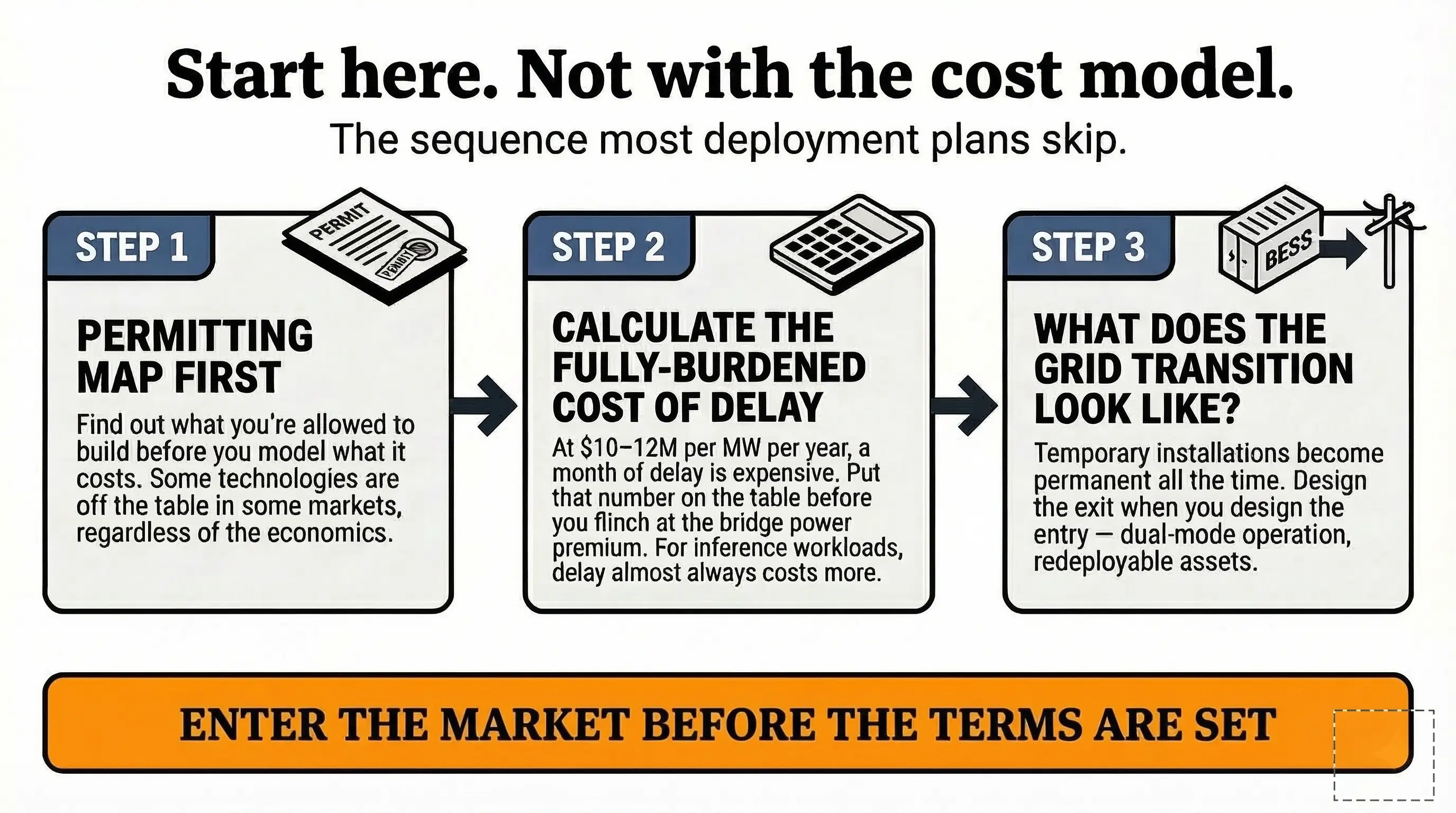
The operators moving in this market aren't the ones who found a way to make bridge power cheap. They're the ones who understood what it was actually buying: entry into markets before the terms were set, on a timeline that captures the early period before the market settles.
The cost was always secondary to that. It still is.