Smaller Isn't Easier
The edge AI story has been strong but it has a blind spot; location. Smaller facilities have the allure of faster permitting, lighter infrastructure requirements, less of everything that makes hyperscale development slow and expensive. All the upside of distributed compute without the friction of building at scale.
It seems reasonable but often neglects to consider where this edge AI needs to live.
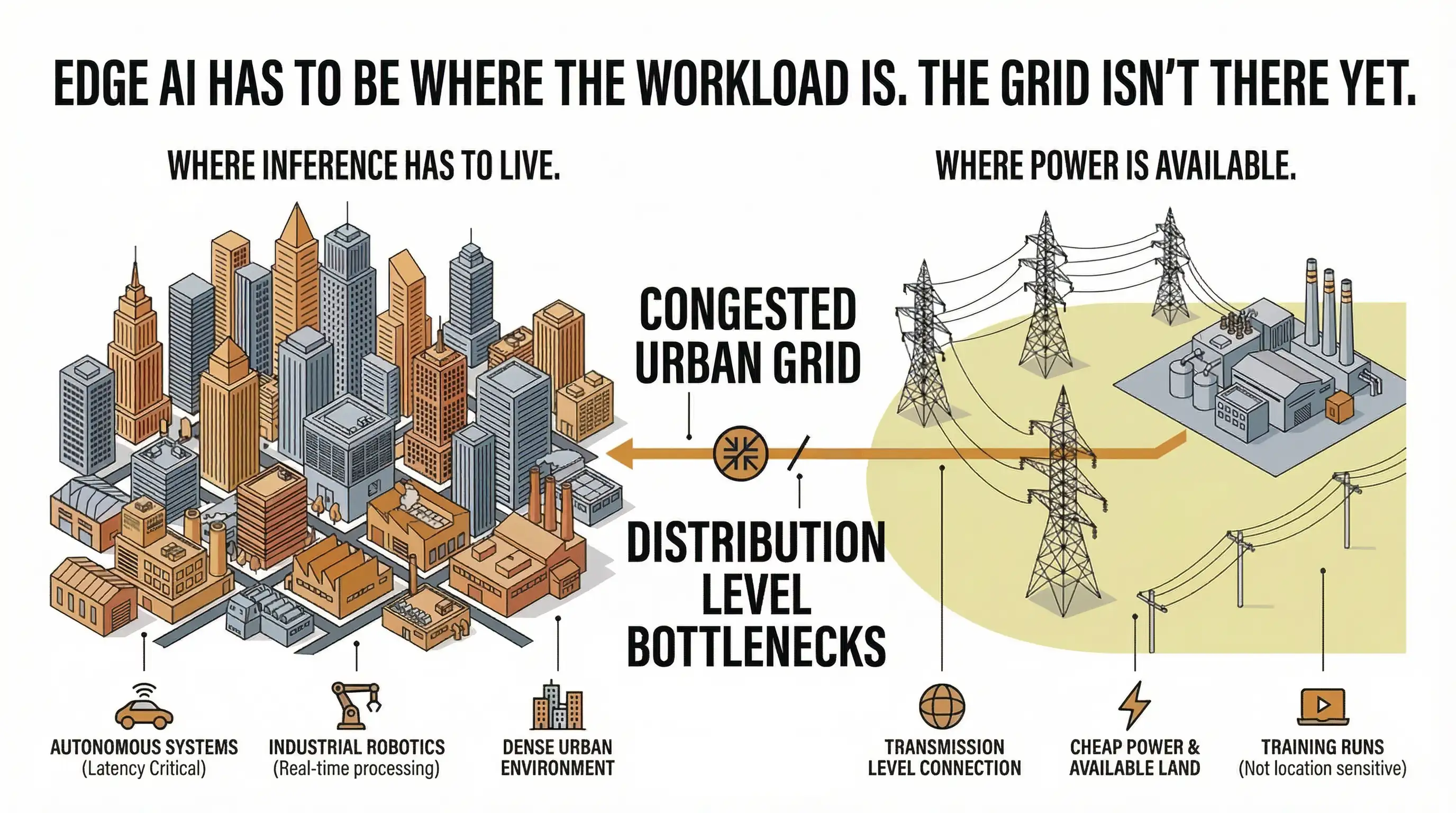
Where inference has to live
The distinction between training and inference gets raised constantly in this industry. What it doesn't get is actual operational weight.
Training doesn't care where it happens, as long as it’s a big facility. You put a cluster in rural Texas or eastern Oregon, wherever power is cheap and land is available, and the model being trained there does the same thing as one trained anywhere else. The facility can be wherever the economics point. The load is also predictable - a training run draws what it draws, on a schedule you set.
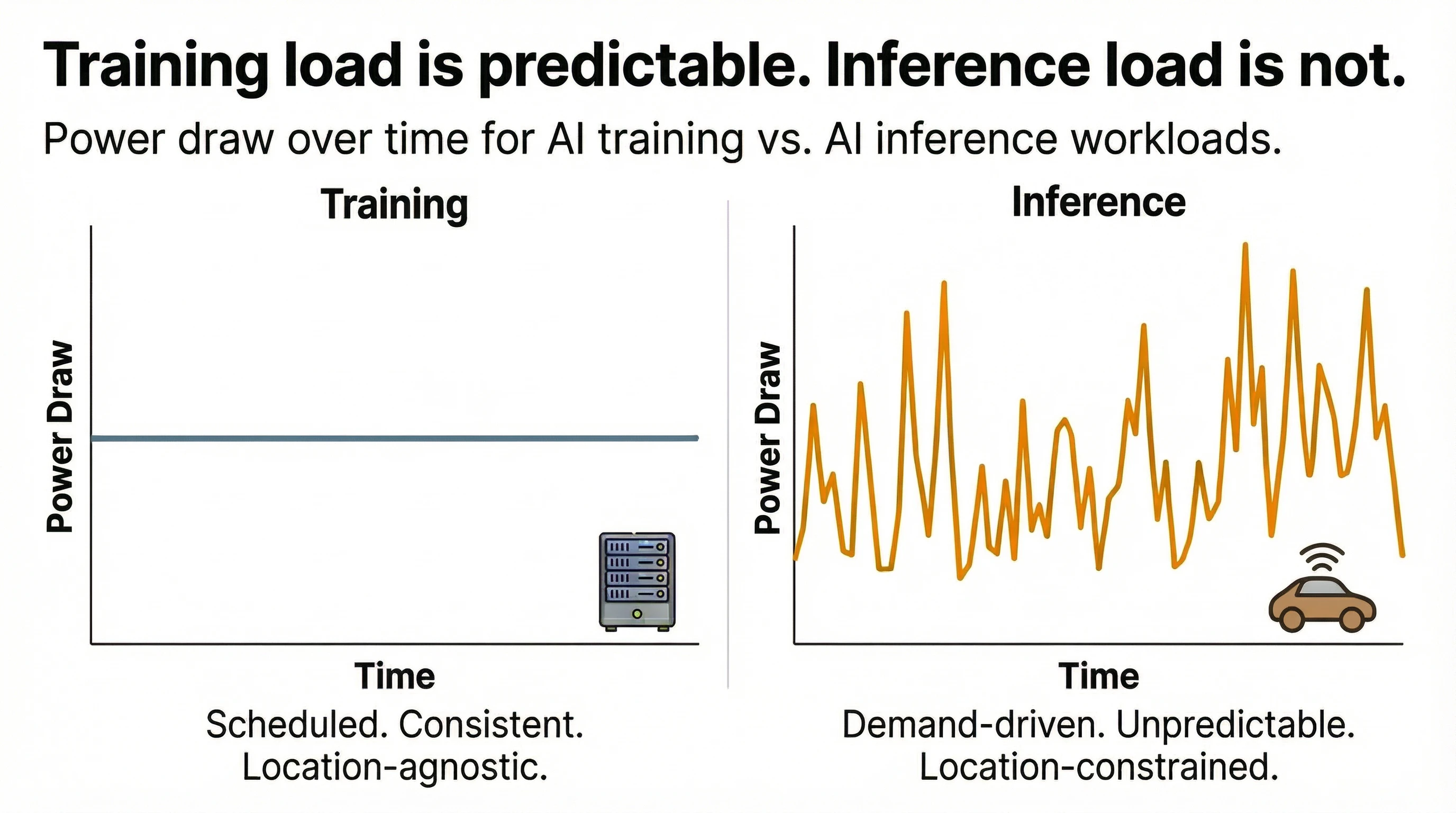
Inference is the opposite problem entirely. Autonomous systems, industrial robotics, real-time processing - these applications are constrained by requirements that extend well beyond just latency. The need for proximity is driven by physical necessity, but also commercial, regulatory, and financial reasons (e.g., CDN nodes for ad-targeting, high data volume processing, or data sovereignty compliance) that demand the compute be near the workload. And near the workload, for the industries driving edge AI demand, means dense urban environments and specific industrial corridors. Not the places that show up on anyone's list of ideal data center locations. The places with the most constrained grids, the most complicated permitting, and the loudest neighbors. And unlike training, the load doesn't arrive on a schedule - it spikes when the workload spikes, which is exactly when you can least afford the infrastructure to buckle.
What load size conceals
Edge AI inference typically lands in the 2 to 20 MW range. Against a hyperscale campus, that sounds manageable. The problem is that load size and deployment difficulty aren't the same thing.
A hyperscale facility connects at the transmission level with dedicated high-voltage infrastructure, purpose-built for the load, expensive enough that only projects above a certain scale can justify it. A 2 to 20 MW edge deployment connects at the distribution level, through the local utility's existing feeder infrastructure. That sounds like the simpler path. In dense urban environments, it isn't.
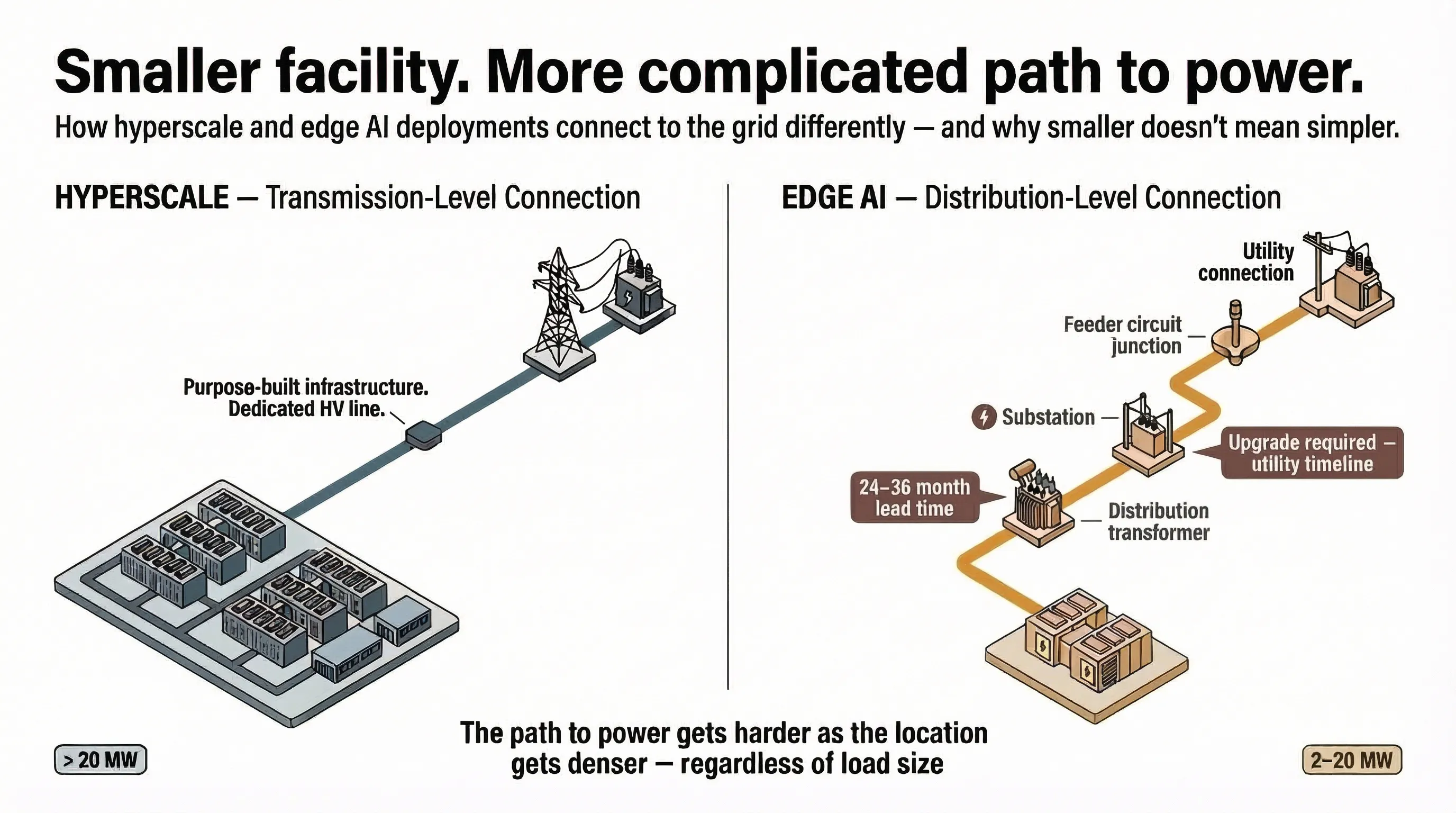
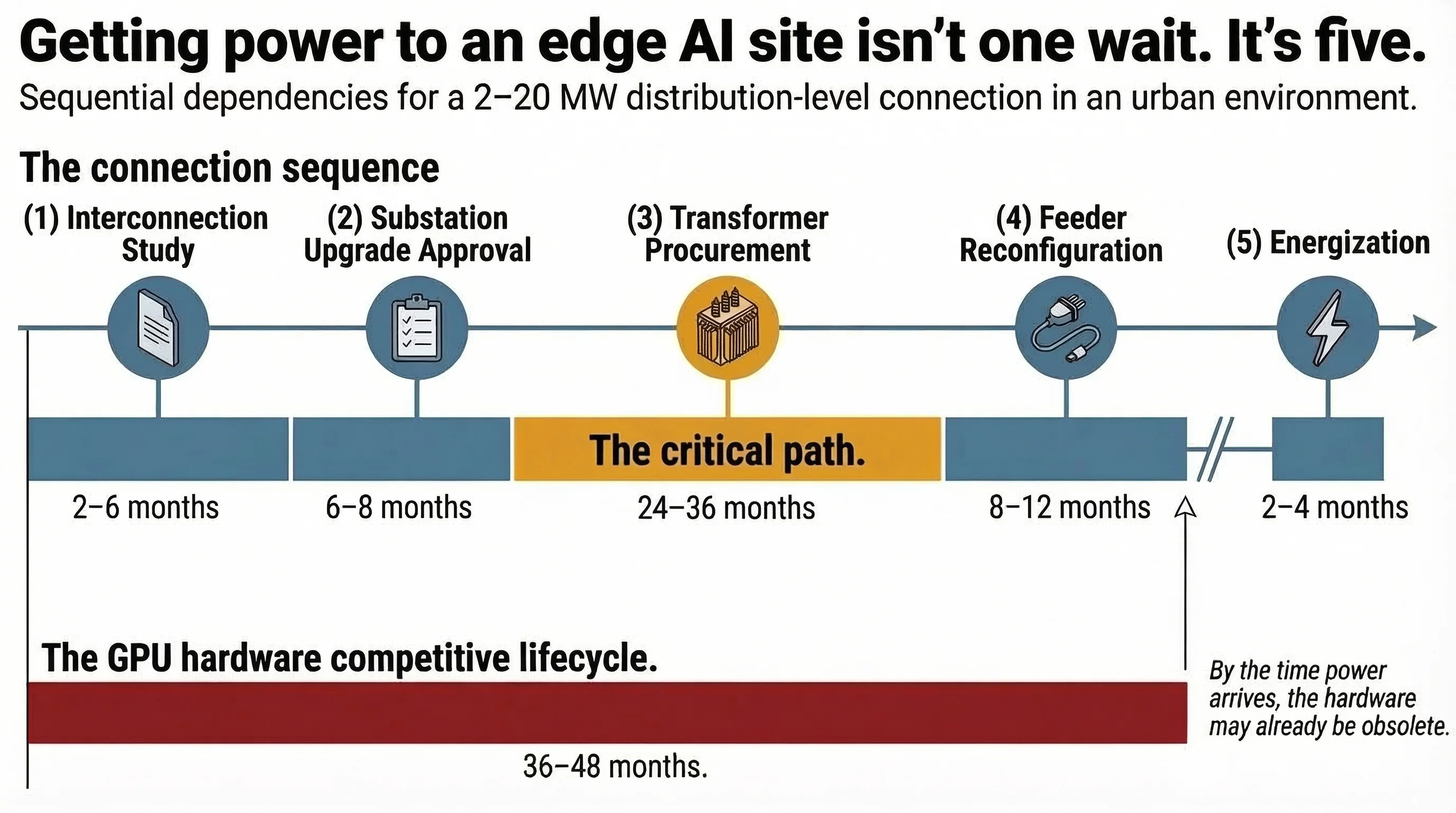
Distribution grids in those environments weren't designed to absorb a continuous high-density industrial load dropped onto a local feeder circuit. Doing it requires substation upgrades, transformer replacements, and in many cases feeder reconfiguration - work that sits entirely within the local utility's queue and capital plan, on the local utility's timeline. That timeline has its own problems. Distribution-level transformers currently run 24 to 36 months on lead time. Substation upgrades in constrained urban jurisdictions involve permitting, land, and community process that don't compress because the requesting load is modest.
You're not waiting for one thing. You're waiting for a sequence of things, each with its own clock, none of which moves faster because your project is smaller than the transmission-scale development happening two jurisdictions over.
The novelty isn't the megawatts
Here's what gets lost in the urgency: 2 to 20 MW is not a novel load. Factories, hospitals, large commercial complexes - they've been drawing power at this scale for decades, in thousands of locations, through standard utility processes. The supply chain, strained as it currently is, is fundamentally oriented around this load category. The grid knows how to serve it.
What the grid doesn't know how to do is serve it fast, in dense urban environments, on a timeline measured in months rather than years.
A factory going up in an outer suburb has location flexibility, construction timelines that absorb utility lead times, and relationships with local utilities built over years of prior projects. An edge AI deployment going into a dense urban corridor has none of that. It needs to be where the workload is, operational before the market window closes, in a jurisdiction with congested distribution infrastructure, limited available land, stricter environmental permitting - and neighbors with strong opinions about generators running at all hours.
Those problems are solvable but they're not the problems the "smaller means easier" frame prepares you for.
What deployment actually looks like
Fort Worth's Rock Creek data center campus - $750 million, purpose-built, serious capital behind it - required a contested City Council override to move forward. Santa Clara's municipal utility has essentially exhausted its immediate high-voltage capacity and is executing a $450 million upgrade program that won't complete until 2028. There are built data centers in that market sitting idle right now, waiting for power that exists nearby but can't reach them on any useful timeline.
The operators making progress in these conditions are working around the distribution grid entirely - behind-the-meter, modular generation deployed in weeks rather than years, at a meaningful cost premium over grid power. The premium is real. So is the math on the other side: in markets where enterprise relationships and operational incumbency go to whoever shows up first with working infrastructure, delay isn't just deferred revenue. It's deferred position. And position in infrastructure compounds differently than in software. A competitor can displace a better application quickly. Displacing an operator who's been running infrastructure in a market for three years is a different problem.
Some markets add an environmental constraint on top of the grid constraint. Jurisdictions with aggressive decarbonization commitments or strict air quality regulations - and the edge AI buildout is concentrated in several of them - make standard diesel bridging difficult or impossible to permit. California's air quality management districts have real enforcement teeth; in the Bay Area and LA, diesel doesn't clear permitting in the way it might elsewhere. The Pacific Northwest runs on hydroelectric power and has the environmental commitments to match - utilities and municipalities there apply meaningful friction to combustion-based solutions regardless of their scale. In both cases, operators are pushed toward fuel-agnostic generation, BESS integration, hydrogen or RNG where supply chains support it. Not the default answers, and not the answers you arrive at if you assumed proximity to customers was the only variable that changed.
What the queue is deciding
None of this means edge AI infrastructure is impossible to build in constrained urban environments. The load sizes involved aren't novel. The companies establishing positions in these markets are doing it with bridge solutions that cost more than anyone would choose if better options were available on the same schedule.
What it means is that the operators who are actually deploying right now went in with a different model of the problem than the one the industry tends to present. They planned for the grid as it operates in dense urban corridors, not as it theoretically should. They treated the location pressure and the timeline pressure as the actual constraints, not as complications that would sort themselves out.
The ones still waiting for smaller to mean easier are in a long queue. And in a market forming this fast, the queue isn't just expensive. It might be disqualifying.